
02 · Test & Measurement
Vibration Micro-Drop Test
Catch loose parts that pass a static test.
Vibrates the powered PCB or lamp and samples its current continuously, flagging interruptions of one millisecond and shorter from loose parts, cracked joints or connector fretting.
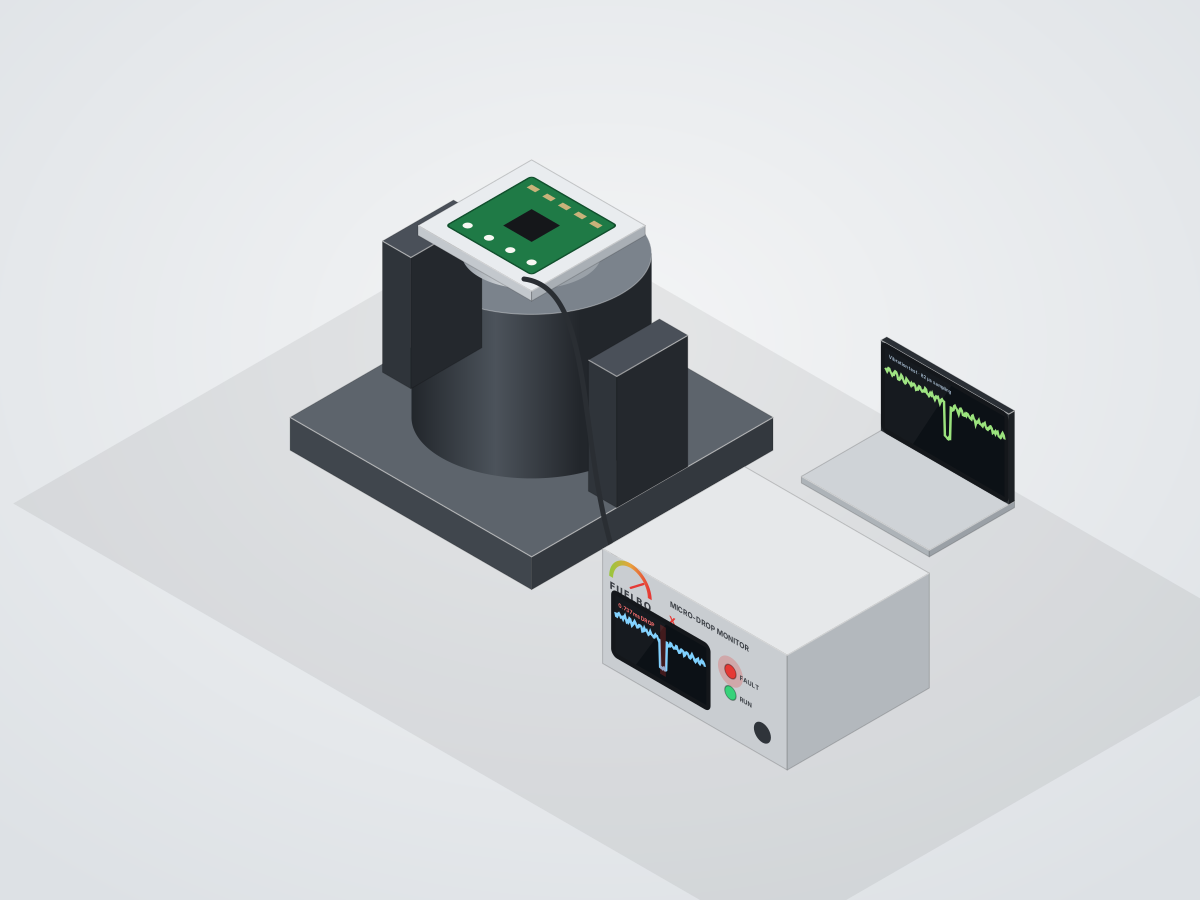
drop captured in a live trial (9 samples)
interruptions detected
sample spacing in the trial
Why static tests miss these faults
Loose components, cracked solder joints and connector fretting can open a circuit for less than a millisecond, and only while the part is vibrating. On a static bench the part looks perfect. On the road it flickers or fails.
Two conditions, low false rejects
A fault needs both conditions: the current falls below the drop threshold and stays there longer than the minimum drop time. Short switching glitches are ignored, so good parts are not rejected.
Interactive
How a micro-drop is detected
Red = drop below threshold for longer than the minimum time (fault). Grey = short switching glitch (ignored).
How it works
- 01
Shake
The powered PCB or lamp runs a product-specific vibration profile on the shaker.
- 02
Monitor
Supply current is sampled continuously at high speed for the whole profile.
- 03
Flag
Every drop below the threshold for longer than the minimum time is flagged
Specifications
- Detection
- Current below drop threshold AND longer than minimum drop time
- Minimum drop time
- Settable down to sub-millisecond (e.g. 0.70 ms)
- Pre-trigger
- Configurable % of signal kept before each event
- Fault limit
- Number of drops allowed before FAIL
- Output
- PASS / FAIL, waveform, CSV, PNG, report
Final configuration is designed to your parts, cycle time and specifications.
Start a project
Let's scope your Vibration Micro-Drop Test.
Send us a sample, a drawing or just a description. An engineer, not a salesperson, will reply within one working day.